
Posted on
October 27, 2010 by
Tom Jansen
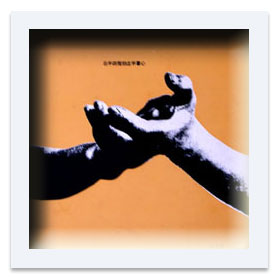
Fifty Antoni Tapies’ paintings and drawings are being exhibited at the Palau Fabre Foundation (Fundacion Palau Fabre) from today on in the “Gaze at the Hand” (“Mira la mano…”) exhibition, which shows the vitality of the last ten years of this artist, who has already reached 87 and with which the Foundation opens a new stage.
Arriving simultaneously with the vernissage of the new permanent exhibition, the Foundation has done a redistribution of the spaces assigned to temporary exhibitions, which starts with an exhibition of the recent work of Tapies, chosen by the also artist Perejaume, the director of the center, Josep Sampera, has informed today in a press conference.
The exhibition starts with a dozen of the most recent work of Tapies, created in the last three years, all of them on paper and lots of ink, such as “Stretched Body” (2008, “Cuerpo estirado”), “Arrow Body” (2008, “Cuerpo flecha”), “Blue Ink” (2007, “Tinta azul”), “Black on Red” (2008, “Negro sobre rojo”), or “White Eyes” (2007 “Ojos blancos”).
Read the full article
Tags: Antoni TapiesexhibitionPalau Fabre
Category
Exhibitions, General News
Posted on
October 24, 2010 by
Tom Jansen
PARIS—Strolling from Adel Abdessemed’s compressed block of taxidermy animals to an enormously twirling Anish Kapooralpenhorn, it’s clear that Paris’s FIAC fair is not on the shy side this year. The cautiousness of 2009 is long forgotten, and the fair is filled with sometimes-outrageous contemporary work and some daring propositions. Nevertheless, it is a testament to the quality of this year’s fair that it has taken ARTINFO France a good few days to finalize its list of the best booths in the Grand Palais, which are listed below.
Christian Stein, B21
Installing a full-length mirror along one wall of a large stand is a gamble, but Christian Stein has turned it into a conversation-starter of sorts between different works. The mirror is, in fact, fromMichelangelo Pistoletto’s “Trans Border” series, and its painted red netting wonderfully matches its reflection of Gilbert & George’s equally volumous work “Pull.” Accenting the setup on either side is Jack Pierson’s found-letter sign “The Unknown” and an installation of yellow bulbs and black-and-white photographs byChristian Boltanski. Christian Stein’s stand achieves a great equilibrium and a true dialogue between the works on view.


Read the full article
Tags: Best boothsexhibitionFIACParis
Category
Art, Exhibitions
Posted on
October 18, 2010 by
admin
PITTSBURGH, PA.- Carnegie Museum of Art presents Ordinary Madness, an exhibition that mines the museum’s rich holdings of contemporary art to suggest an unsettling observation: that the ordinary is in fact laced with the contradictory, uncanny, and surreal.
On view are a wide array of works that engage the everyday from various vantage points, illuminating the bewildering experiences we subconsciously accept as part of our daily lives. At the heart of the exhibition are the strengths, quirks, and unique history that comprise the museum’s collection of contemporary art.
“Ordinary Madness came together from my desire to present a series of comparisons across media and art historical categories that would articulate how artists engage with everyday experience, and the way art can be used as a powerful tool to navigate a complex and disconcerting world,” said Dan Byers, curator of Ordinary Madness and associate curator of contemporary art at Carnegie Museum of Art.
Ordinary Madness revisits major works acquired from past Carnegie International exhibitions, and presents the opportunity to show a wide range of permanent collection works alongside recent acquisitions, creating juxtaposition and dialogue that otherwise might not be apparent. The exhibition takes place in the Heinz and Forum Galleries and includes a 16 mm film series in October and November in CMA Theater.
Ordinary Madness presents art from the museum’s contemporary art collection thematically as a way to explore connections and comparisons between different works. But overall, the exhibition examines how life is filled with the bizarre and unusual and how art reflects those observations.
Read full article:
Tags: Carnegie MuseumContemporary artDan ByersexhibitionOrdinary Madness
Category
Exhibitions
Posted on
October 18, 2010 by
admin
BARCELONA.- The Museu Picasso in Barcelona presents, from 15 October to 16 January 2011 the major exhibition «Picasso Looks at Degas». The exhibition is curated by Elizabeth Cowling, Professor Emeritus of History of Art at Edinburgh University, and Richard Kendall, the Clark’s Curator at Large and is organized by the Sterling and Francine Clark Art Institute, Williamstown and the Museu Picasso, Barcelona, with the special cooperation of Fundación Almine y Bernard Ruiz-Picasso para el Arte.
Throughout his life Pablo Picasso (1881–1973) was fascinated by the personality and art of Edgar Degas (1834–1917). He collected the Impressionist’s work, often re-interpreted his signature imagery, and at the end of his life created scenes that included depictions of Degas himself. «Picasso Looks at Degas» is the first exhibition to explore the extent and significance of this phenomenon and brings together over one hundred works from international museums and private collections, including many that have never before been shown in Spain. The Museu Picasso is the exclusive European venue for the show, which is curated by Picasso expert Elizabeth Cowling and Impressionist scholar Richard Kendall.
Thanks to his friendship with older artists in Barcelona’s Quatre Gats group, Picasso knew something of Impressionism before his first visit to Paris in 1900. However, what became a sustained dialogue with Degas’s work began to develop only after he started visiting the French capital and seeing examples in the original. When he settled in the Bateau Lavoir in Montmartre in 1904 Picasso was within a few minutes’ walk of Degas’s studio. They had many acquaintances in common in the Parisian art world, including the legendary dealer Ambroise Vollard, but they seem never actually to have met. Using compelling pairings and groupings of works on related themes, the exhibition examines Degas through Picasso’s eyes and the ways in which the Spanish artist’s response varied over time from emulation to confrontation and from parody to homage. Both shared a lifelong obsession with women, visible in their portraits of friends and innumerable representations of the female nude. But Picasso also echoed Degas’s acknowledged signature subjects of café concert performers, ballet dancers, women at their toilette, and prostitutes. While usually identified as painters, both Degas and Picasso were supreme draftsmen and highly innovative sculptors and printmakers, and the exhibition brings together works in all these media in order to examine Picasso’s reaction to the challenge posed by Degas’s oeuvre and the fascinating affinity between their creative thinking and working methods.
Read full article:
Tags: BarcelonaEdgar DegasElizabeth CowlingexhibitionPablo PicassoThe Museu Picasso
Category
Exhibitions
Posted on
October 18, 2010 by
admin
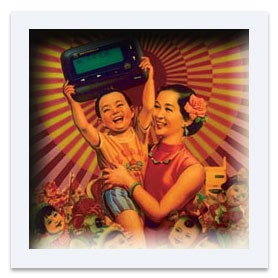
CHICAGO, IL.- This fall, the Museum of Contemporary Art (MCA), Chicago, presents Urban China: Informal Cities, an exhibition that draws parallels between how cities across the globe, from Chinese cities to Chicago, grow and transform. This retrospective of the only magazine devoted to issues of urbanism published in China, marks Urban China’s first U.S. commission. With its unique multidisciplinary inquiry into the rapid state of change in China — employing diagrams, photographs, texts, and archive of artifacts and images — Urban China has become a databank recording the fastest urbanization in history. Utilizing a network of correspondents and collaborators around the world, Urban China has become a research network, think tank, documentary archive, and tool for artistic production and urban activism.
For the interactive Chicago presentation, the magazine’s visionary language of display explodes out from the pages onto the walls, with space available for the public to comment on the issues presented. Comprised of an interactive image database; massively scaled interactive wall graphics; a suite of scavenged “readily remade” objects; a re-creation of ad hoc refugee housing; and a retrospective of past magazines, the installation fuses interrelated elements to better understand common issues between Chinese cities, Chicago, and cities across the globe. The wall graphic includes Urban China magazine’s Editor-in-Chief Jiang Jun’s research of historical and contemporary urbanization in China, Chicago’s Mas Studio’s Iker Gil’s history of the urbanization of Chicago, and texts from experimental architect Kyong Park, and director of New York’s Skyscraper Museum’s Carol Willis. The presentation highlights the dynamics of urbanism as metropolitan cities adapt to multiple influences, including re-urbanism and informal transformation. Also included are objects and remnants of American manufacturing in China, which suggests how informalism can be used as a strategy for individuals.
Read full article:
Tags: ChicagochinaexhibitionInformal Citiesmagazinemetropolitan citiesMuseum of Contemporary Arturbanism
Category
Exhibitions
Posted on
October 18, 2010 by
admin
LONDON.- The Modern Masters Gallery presents a major new exhibition dedicated to the master of Surrealism, Salvador Dalí, ‘Vision of a Genius’. This new exhibition running until February 28th, 2011, is to be held at the gallery which is located on Cork Street, in the heart of Mayfair, London’s famous fine art quarter.
The exhibition consists of a grouping of Dalí artworks in three-dimensions and a rare, never seen before in the UK, collection of paintings, drawings and watercolours. Amongst the three -dimensional artworks on show are three iconographic sculptures from the 1960s. These are, ‘The Shoe, Surrealist object with a Symbolic Function’, and the striking ‘Buste de Femme Retrospectif’ (originally dating from 1933), including bread, ants, inkwells, and corn, all decorating a milliners bust. The first Buste de Femme was exhibited in Paris alongside artworks by Paul Eluard, Breton and Duchamp, at the Pierre Colle Gallery in the 1930s.
Completing the series is the surreal and iconic ‘Lobster Telephone’, an authorised recreation of the 1936 artwork. Curator of the exhibition for the sculptures and President of the Stratton Foundation, Mr. Beniamino Levi is an avid collector and expert on Dalí. He has carefully chosen the artworks in order to bring various aspects of Dalí’s lifework to the public eye.
Read full article:
Tags: Buste de Femme RetrospectifexhibitionSalvador DaliSurrealismThe Modern Masters Gallerythree-dimensionsVision of a Genius
Category
Exhibitions
Posted on
October 16, 2010 by
admin
PARIS.- Following the major exhibition “Holy Russia: Russian Art from the Beginnings to Peter the Great” in spring 2010, the Louvre hosts a second event in honor of the Year of Russia in France. Turning its focus to present-day Russia, the museum offers an overview of Russian contemporary art, still little known in France. This exhibition in the Louvre’s annual “Counterpoint” series features works by some twenty artists and artist collectives: AES + F Group, Yuri Albert, Blue Noses, Erik Boulatov, Alexander Brodsky, Olga Chernysheva, Dubossarsky and Vinogradov, Dmitri Gutov, Emilia and Ilya Kabakov, Alexei Kallima, Komar and Melamid, Valery Koshlyakov, Yuri Leiderman, Igor Makarevich and Elena Elagina, Diana Machulina, Andrei Monastyrsky, Pavel Pepperstein, Avdei Ter-Oganian, and Vadim Zakharov.
The exhibition is presented in the moats, in the Salle de la Maquette, at the keep, and in the Salle Saint-Louis, all of which provide evidence of the 12th-century fortress that predates the Louvre Palace on this site, unearthed in the course of the Grand Louvre project. These archaeological remnants reflect architectural utopias, which are echoed in the explorations of some of the artists included in the exhibition, such as Ilya Kabakov and Igor Makarevich. This underground space also stimulates fantasy and the imagination, as shown in the works of Alexei Kallima, Valery Koshlyakov and Vadim Zakharov. In fact, most of the featured artists have created a work specifically suited to the architecture of the museum. For instance, Yuri Leiderman will present a performance piece in his “Geopoetics” series at the press opening, whereas Yuri Albert will invite visitors to explore the collections blindfolded. In connection with this “Counterpoint” exhibition, the Tuileries gardens will play host to Rotunda II, an installation project by the Russian architect and sculptor Alexander Brodsky, on loan from the PERMM Museum of Contemporary Art in Perm, Russia.
Read full article:
Tags: Alexander BrodskyexhibitionLouvreParisRussian Contemporary ArtYuri Leiderman
Category
Exhibitions
Posted on
October 16, 2010 by
admin
FRANKFURT.- The French painter Gustave Courbet (1819–1877) ranks among the most fascinating nineteenth-century artists. He is regarded as the crucial pioneer of political realistic painting and as a revolutionary of the Paris Commune. But Courbet also had an entirely different side: he was one of the great dreamers in history. In his portraits, but also in his landscapes, drawings, and still-lifes, he depicts a world of absorption and introversion – in stark contrast to the frenzied industrialization of his age. One hundred works from eleven countries – among them loans from Stockholm, Paris, Montpellier, Los Angeles, New York, and Oslo – will present this “other” Courbet for the first time in the Schirn Kunsthalle Frankfurt from October 15, 2010 to January 30, 2011. Curated by Professor Klaus Herding, the exhibition reveals how Courbet, from a starting point in German Romanticism, realized the vision of a poetic art of Modernity, later to be further developed by Cézanne and Picasso, as well as in the schools of Symbolism, Surrealism, and Magic Realism. Why so many contemporary artists refer to Courbet may also result from the sonambulistic sensualism, which many of Courbet’s works radiate, and their immersion into remote areas concealed from the outside world.
Gustave Courbet, born into a middle-class family in Ornans near Besançon in the Franche-Comté region in 1819, has always been regarded as an advocate of socially committed art. His painting “The Stonebreakers” from 1849 (probably destroyed in 1945), which shows two day laborers without covering up their wretched everyday hardship, has often been cited as an example in this context. Courbet’s work has also been associated with his engagement in the Paris Commune. It was in 1873 when the artist alone was blamed for the dismantling of the Vendôme Column erected in celebration of the Napoleonic Wars by the Paris Commune in May 1871. Before he was sentenced to pay the expenses for its re-erection, he took refuge in Switzerland, where he died in La Tour-de-Peilz on Lake Geneva in 1877.
Read full article:
Tags: exhibitionFrankfurtGustave CourbetPoetic artpolitical realistic paintingSchirn Kunsthalle
Category
Exhibitions
Posted on
October 14, 2010 by
admin
LONDON.- This autumn, to coincide with the Sainsbury Wing exhibition Venice: Canaletto and his Rivals, the National Gallery has invited contemporary artists Clive Head and Ben Johnson to display their work in two consecutive exhibitions in Room 1. Both artists paint the city, but for very different reasons, and with very different outcomes. The displays will reveal their motivations and working processes – and their fascination with the legacy of Canaletto. In the second of these two displays, Ben Johnson will be completing one of his paintings in public.
Following the example of Canaletto, both artists combine and manipulate different views to make paintings that are completely convincing. Along with large-scale cityscapes including depictions of London landmarks Piccadilly Circus and Trafalgar Square, preparatory drawings and photographs will be shown that will demonstrate how these two artists produce such apparently realistic paintings with differing techniques and tools.
Read full article:
Tags: Ben JohnsonCanalettoClive HeadexhibitionLondonNational Gallery
Category
Exhibitions
Posted on
October 13, 2010 by
admin
Cleverly opening to VIPs just before Frieze, the second edition of the 50-dealer-strong Pavilion of Art & Design London drew an international and decidedly elegant crowd into the snooty hedge fund territory of Berkeley Square on Monday evening. Commerce was a bit slow, according to several exhibitors, but no one was complaining about the high net worth of the tony crowds that trolled along the carpeted aisles of the small-scale, tented fair, which also boasts a number of the ancient London Plane trees as part of the décor.
“I think it has everything you want,” said exhibitor James Mayor of London’s Mayor Gallery, “the perfect location, the perfect size, and the guarantee of a very good time. You can go through it peacefully in half an hour.”
Already, Mayor has sold a small early Alexander Calder tabletop mobile from the 1960s in the six-figure pounds range, as well as a stunning suite of four Outsider art pieces — done with ball point pen and colored pencils — by the late Chicagoan Joseph Yoakum in the five-figure range. Included in Yoakum’s suite is the imaginary 1965 landscape entitled “Mt. Victoria on Bengal Bay, Near Chattagong Pakistan,” which measures 12 by 19 inches. As legend has it, Yoakum used to sit on the steps of the Art Institute of Chicago, hawking drawings to tourists and students in exchange for spare change.
Read full article:
Tags: Alexander CalderexhibitionJames MayorJoseph YoakumMayor GalleryPavilion of Art & Design London
Category
Exhibitions